
One API, 30+ Countries: Automating Business Registration Status Checks
Global Business Verification Simplified — Series
- The Hidden Cost of Manual Business Registration Checks
- Why Direct Registry Access Matters for Business Registration Verification
- One API, 30+ Countries: Automating Business Registration Status Checks
- Why E-commerce, Marketplaces, and Supply Chains Need Automated Business Registration Verification
- Defensible by Design: Business Registration Verification for Regulated Industries
Related Reading
Part 3 of the “Global Business Verification Simplified” series
“Imagine checking if a German supplier, Brazilian distributor, and French partner are currently registered, all in under a minute. Not ordering full company reports. Not waiting days for verification services. Just answering the essential first question: Are these businesses legitimately registered?”
For most organizations, this scenario sounds impossible. Verifying business registration across multiple countries means navigating dozens of different registry systems, each with its own interface, language, data format, and access method.
But it doesn’t have to be this way.
The Multi-Country Registration Challenge
In the first two articles of this series, we explored the hidden costs of manual verification and why data freshness matters. Now we face a practical question: how do you actually implement efficient, scalable business registration verification across 30+ countries?
The challenge is fragmentation. Every country maintains its own business registry:
Germany uses the Handelsregister with Handelsregisternummer. But Germany’s federal system means the same registration number can exist in multiple regional registries (Munich, Berlin, Frankfurt, etc.), requiring name matching to identify the correct entity.
France provides access through INPI/Infogreffe with SIREN numbers. Nine-digit identifiers that are unique nationally.
Brazil uses CNPJ registration. Fourteen-digit numbers with specific formatting and checksum requirements.
Slovakia uses two distinct and unrelated identifiers: IČO (the eight-digit business registration number) and DIČ (the Tax Identification Number, or TIN). Many countries use a single unified identifier, but Slovakia keeps these completely separate, which can confuse foreign verification processes that expect them to be linked.
Greece operates GEMI (Γ.Ε.ΜΗ.) with data available through official portals.
Each registry has:
- Different registration number formats and structures
- Different validation rules (some have checksums, some don’t)
- Different data publication schedules (daily, weekly, monthly)
- Different ways to access the data (APIs, data dumps, web interfaces)
- Different definitions of what constitutes “active” status
The same fundamental question — “Is this company currently registered?” — requires 30+ different technical implementations if you’re building it yourself.
What Registration Status Verification Actually Means
Before exploring solutions, let’s be clear about what we’re verifying. Business registration status verification is not:
- Downloading full company reports with directors and financials
- Conducting credit checks or risk assessments
- Performing comprehensive due diligence
- Replacing KYC/AML processes
Registration status verification is:
- Confirming a business registration number exists in the official registry
- Verifying the company name matches the registered name
- Checking the entity’s current status (active, dissolved, suspended)
- Providing a simple MATCH or NO MATCH answer
Input:
- Country code
- Business registration number
- Company name
Output:
- MATCH: The registration number exists, the company is active, and the name matches
- NO MATCH: Either the number doesn’t exist, the company isn’t active, or the name doesn’t match
This is the foundational “go/no-go” check that gates everything else. If this basic verification fails, there’s no point ordering expensive comprehensive reports or conducting detailed due diligence.
The Unified API Approach
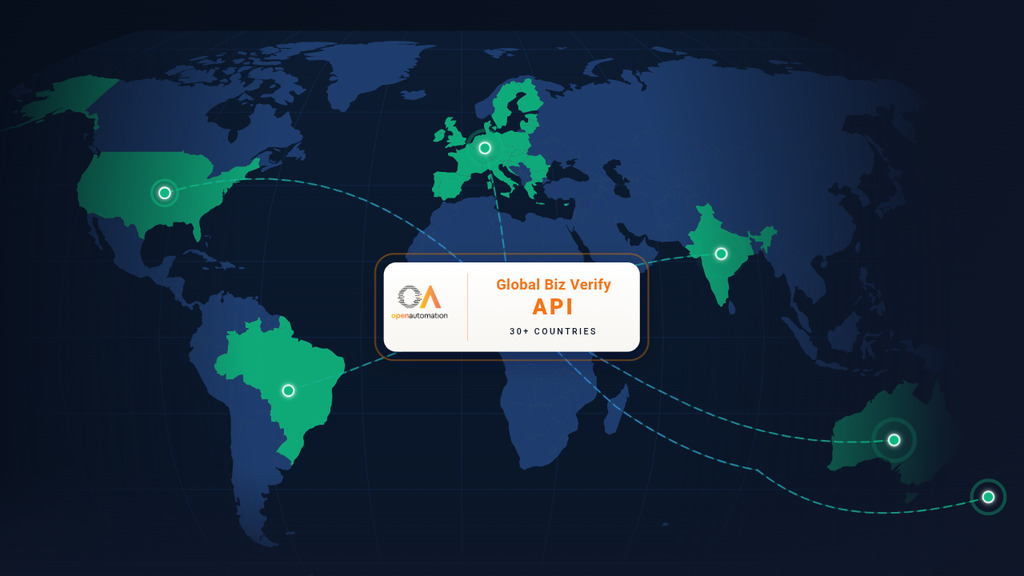
A unified API solves the fragmentation problem by creating a single, standardized interface that works across all countries.
One request format:
Country: DE
Registration Number: HRB 12345
Company Name: Example GmbH
One response format:
Status: MATCH / NO MATCH
Message: Explanation
Behind the scenes, the API handles all the complexity:
- Connects to Germany’s Handelsregister
- Navigates the regional registry structure
- Matches the company name across potential duplicates
- Checks current active status
- Returns a standardized response
The same process works for France, Brazil, Slovakia, India, New Zealand, or any of the 30+ supported countries. You send the same request structure, you get the same response format. The complexity is abstracted away.
Two-Step Validation for Cost Efficiency
A well-designed verification system uses a two-step process:
Step 1: Registration Number Structure Validation
Before querying the registry, validate the registration number format:
- Is it the correct length for this country?
- Does it follow the proper structure?
- Does the checksum (if applicable) calculate correctly?
For Brazil’s CNPJ, this means checking the 14-digit format and validating two checksum digits. For France’s SIREN, it’s nine digits with a specific validation algorithm.
If the format is invalid, you get an immediate NO MATCH without consuming registry query resources. This is especially valuable when processing bulk uploads where formatting errors are common.
Step 2: Registry Verification
Only after Step 1 passes do you query the official registry:
- Is this registration number in the database?
- Is the company currently active (not dissolved, suspended, or inactive)?
- Does the provided name match the registered name?
This two-step approach minimizes costs and improves speed. Invalid formats are caught immediately without expensive registry lookups.
From Initial Screening to Ongoing Monitoring
The unified API approach enables two critical use cases:
Initial Screening
Before unified verification:
- Supplier provides registration details
- Procurement team manually checks foreign registry websites
- 2–3 days pass
- Maybe the company is registered, maybe not
- If verification passes, order expensive full company report
- Wait another 3–5 days
- Sometimes discover the company doesn’t exist, wasting report cost
After unified verification:
- Supplier provides registration details
- API check completes in seconds
- Immediate MATCH or NO MATCH
- If NO MATCH, stop — no wasted expense
- If MATCH, proceed with confidence to full due diligence
- Overall timeline compressed from weeks to days
Ongoing Monitoring
Before unified verification:
- Quarterly review of supplier list
- Manual spot-checks of some suppliers
- Most suppliers never re-verified
- Dissolved companies slip through unnoticed
- Problems discovered only when issues arise
After unified verification:
- Automated quarterly (or monthly) re-verification of entire supplier base
- API checks thousands of companies in minutes
- Immediate alerts when a supplier’s registration status changes
- Proactive problem detection before issues arise
- Audit trail showing continuous monitoring
This is especially critical for:
- Marketplace platforms with thousands of sellers needing continuous verification
- Financial institutions with regulatory monitoring requirements
- Supply chain operations managing hundreds of international suppliers
- Payment processors needing current registration data for VoP compliance
Real-World Scenarios
Scenario 1: New Marketplace Seller
A European marketplace receives 500 seller applications per month from 20+ countries.
Manual process: Impossible to verify them all. Spot-check a few, approve the rest based on submitted documents.
Unified API: Automated verification of every applicant. 500 checks complete in under an hour. Only applicants with valid registrations proceed to document review. Fraud prevention from day one.
Scenario 2: Supplier Onboarding
A manufacturing company qualifies new suppliers across Germany, Poland, and Slovakia.
Manual process: Each country requires different internal procedures. Procurement team needs to learn each registry system. Verification takes 5–10 days per supplier.
Unified API: Same process for all countries. Registration verified in seconds. Team focuses on evaluating manufacturing capabilities, not learning registry websites.
Scenario 3: Quarterly Compliance Review
A bank must re-verify 1,000 business clients quarterly for KYC compliance.
Manual process: Assign the task to compliance team. Manually check some registries, accept self-attestation for others. Takes two weeks, incomplete coverage.
Unified API: Automated batch verification overnight. 1,000 companies checked while staff sleeps. Morning report shows which clients need attention. Full coverage, complete audit trail.
The Infrastructure You Don’t Have to Build
Implementing unified business registration verification yourself means:
- Researching 30+ different national registry systems
- Understanding each country’s registration number formats and validation rules
- Building integrations to APIs, data dumps, and web interfaces
- Handling different data publication schedules and update frequencies
- Adapting to each registry’s own maintenance schedule and downtime windows
- Monitoring for changes in registry access methods or data formats
- Maintaining fallback options when registries are unavailable
- Standardizing responses across inconsistent data structures
- Managing the infrastructure to handle thousands of daily checks
- Staying current as registries add new features or change access methods
This is months or years of development work, ongoing maintenance, and specialized expertise across multiple countries and languages.
A unified API delivers this infrastructure as a service. The complexity exists, but you don’t have to build or maintain it.
Automate the First Gate
In the first article, we discussed the hidden costs of manual verification. In the second, we explained why data freshness matters and why direct registry access is essential.
This third article addresses the practical implementation: how do you actually do this across 30+ countries without building massive infrastructure?
The answer is a unified API that:
- Standardizes the request/response format across all countries
- Handles the complexity of different registry systems behind the scenes
- Provides two-step validation for cost efficiency
- Enables both initial screening and ongoing monitoring
- Scales from 10 verifications to 10,000 with the same simple interface
Business registration status verification is the first gate. It’s the check that determines whether you invest time and money in deeper verification. This gate shouldn’t require 30+ different processes, manual effort, and weeks of waiting.
Automate this gate. Let the API handle the complexity. Focus your team’s expertise on the deeper due diligence that comes after entities clear the basic registration check.
Next in this series: We’ll explore specific industry use cases, from marketplace sellers to supply chain partners, showing when and why fast registration verification matters.
GlobalBizVerify API provides automated business registration verification across 30+ countries through a single, unified interface. Available on AWS Marketplace. Contact us for pricing details and a free consultation, or learn more at open-automation.io/global-biz-verify-api.